Saturday, February 27, 2016

Labas? Ca va? Que tal?

One of my main concerns before we moved to Morocco was figuring out which language I would speak. Darija, a dialect of Arabic that is specific to Morocco is the main, spoken language here, Modern Standard Arabic is the main written language and French is the second language, a holdover from colonialism that is still taught in schools. But then there’s also the many dialects of Tamazight, the original language of Morocco. A few years ago the king declared Tamazight an official language of Morocco, and for a while it was taught in schools, too. Most people seem to think this is a really good thing. However, it’s not that simple. It’s a difficult language to teach and, as a friend pointed out to me, with so many different dialects stemming from so many different tribes, how do you choose just one?

One challenge of Darija is that it’s not a written language. People do write it, when sending emails or text messages, but it’s not written or learned in schools and books written only in Darija don’t seem to exist. So students in Moroccan schools learn Arabic and French and, when they’re older, have the choice of learning English.

Being multi-lingual means you can write desk graffiti in multiple ways.
All of this makes it easier to see why, when we asked people which language would be most useful for us to learn before coming to Tangier the answers were so confusing and varied. Some people said Spanish would work, others said English would probably be okay. The guidebooks all said French would be spoken everywhere, but in Tangier people (especially young people) seem to prefer Spanish, citing the fact that French is “old-fashioned” and too closely linked with the colonialism. With all these language choices we weren’t really sure what to do to prepare. Elliot speaks French, so we figured we wouldn’t be totally clueless. I did my part by downloading a fairly rudimentary Darija app onto my phone (one of the only resources which seems to exist) and panicking. 

Languages are a little bit of a sore spot for me. I’ve always wondered at the fact that the American education system doesn’t seem to give languages the weight of other subjects in school. It seems like we have a bad habit of assuming everyone not only speaks English but wants to speak English with us. A certain, particularly distasteful bumper sticker that I once saw comes to mind: “If you don’t speak English, get out of America.” It’s an ego-centric but also sort of bizarre sentiment that I think reflects the worst parts of American society.  

Moroccans are understandably proud of the fact that they speak so many languages, and seem somewhat baffled as to why we don’t do the same. As one friend put it recently, “We understand everyone’s language, but nobody understands ours.”


The Cervantes Institute of Tangier 
This was made somewhat painfully clear in my Spanish class a couple of weeks ago. The class is through the Cervantes Institute, a Spanish organization and one of the many language centers available in Tangier. I was somewhat conflicted about taking a Spanish class here, but Darija classes are hard to come by and even Moroccans say it’s hardly worth trying if you are only in the country for a few months. Plus, I’ve always wanted to learn Spanish (even if my weak high school attempts indicate otherwise) and this seemed like the perfect time to do it. It has been amazing, a definite highlight of being here, but it’s humbling, too. My teacher doesn’t speak any English so it’s sink or swim, and confusions abound. Just last week I told my class that family is not important to Americans. Meanwhile, Elliot was across town, announcing to his French class he was profoundly insane.

I’ve learned more Spanish in the last few months than I did in a year of high school (I guess I don’t spend so much time doodling and passing secret notes) and have really enjoyed getting to know some of my classmates. One of the questions we recently learned to ask was: “What languages do you speak,” a question which, in and of itself, is very Moroccan. The teacher prefaced the lesson by saying that Moroccans are particularly gifted in languages, that they speak more languages than, say the Spaniards, who only speak Spanish, The French who only speak French, and the AMERICANS, who ONLY speak English. I was trying to come up with the words to explain that while yes, we might not speak as many languages as people do in Morocco, there are many languages spoken in the US. Then she turned to me:
“Kate. Que lenguas hablas?”
When I answered, in bad Spanish, that I spoke English and Swedish, she crossed her arms, momentarily horrified.
“TU? Tu, hablar SUECA?” she said in disbelief.
But my triumphant moment was shortlived, and her point was proven when she turned to my friend Hafssa, a polyglot who speaks Ingles, Francais, Arabe dialect, Arabe, and Turko.  

Point proven, Senora. 


I learned to write my name from a 13-year old who speaks four languages.
The multi-language situation can be, inevitably, difficult. We never really know what to say to people. We try Darija, but it is almost always the case that whoever we are speaking to speaks a language we speak better than we speak Darija.  And they don’t know what to make of us, either. People address us in a variety of languages: French, Spanish, Italian, German and English, sometimes in the same day. But they never seem to be grumpy about doing so. In fact, when we hobble through Darija people get really excited, throwing out new words and helping us along. People here seem to genuinely enjoy learning and speaking new languages. When I have coffee with Hafssa and her friends they often speak four different languages: Darija, French, English and Spanish, sometimes within a single sentence, just because they think it’s fun.

You don't have to speak the language to know what's going on here. 
We’ve received multiple offers from people who say that if we left Cecily with them for just a month they’d teach her Arabic. Obviously, we are planning on taking them up on this offer while we are maxin’ and relaxin’ at the beach. But recently it crossed my mind that they might actually be concerned for Cecily’s monolingual future. A friend recently asked us if we would encourage Cecily to speak another language. Obviously, we said we would. We mentioned the dual immersion programs and the fact that we felt it was crucial for the next generation to speak Spanish. But in American society the odds that she will become fluent in a second language are actually against her. It’s too bad. Moroccans seem to have figured out what we haven’t—that each new language offers new opportunities for both professional and personal growth. But more importantly, it seems to me that the fact that people here seem so welcoming and tolerant of foreigners has to do with the fact that they are able to communicate with people who come from so many different places. Maybe it’s harder to pass judgment on someone when you can understand what they’re saying. During this time of border patrolling and immigrant reforming and general miscommunication, it seems like something we should learn from.


Sunday, February 21, 2016

Marrakech

For as long as we’ve been planning to come to Morocco, we’ve known that we wanted to visit the southern part of the country. Even Moroccans in Tangier call the south “real” Morocco. There’s the Atlas mountains, the desert and the Berber villages. And there’s Marrakech, the place people seem to picture when they talk about Morocco, with its famed snake charmers, storytellers and souks. Marrakech is even the subject of at least a few songs so if you prefer your blog reading to be accompanied by music (doesn’t everyone?). Click here for a song which you probably know and here for a song which you almost definitely don’t.

So when the schools went on break and my parents decided that they would be coming to Morocco and wanted to visit Marrakech, we decided to hop on their bandwagon and meet them there. Luckily they were prepared, because some of us (Cecily) hadn’t done our research. The planning for our voyage went something like this:
Me: We want to go to the Sahara and take a picture of the baby riding a camel. So we’ll probably take a three- or four-hour bus ride from Marrakech, hop on some camels and check it off the old bucket list.

My dad: GREAT, we want to visit the Sahara, too! So glad you brought this up. But we looked at a map and noticed it’s a little farther than you mentioned. About 11-12 hours of driving with a few overnight stops including a stay in a desert camp.
He was right, of course. Maps are interesting in that way. But by then we were committed and nobody wanted to be the one to shut down the adventure. So we signed-on for a four day excursion, complete with camel trekking and an overnight stay in the desert.

“Think of it like an expedition, “ Elliot said. “It will be Type 2 fun.” Type 1 fun is fun. Type 2 fun is fun to think about after you're all finished. Living with Elliot has shown me that this is a key distinction.

And so, with those words of encouragement to spur us on we began our “expedition.” Step one was the night train from Tangier to Marrakech. We’d been both dreading and looking forward to that part of the journey for some time. On one hand, sleeping on a train and waking up in an entirely different place seems really romantic and multi-tasky. Until you remember the fact that you have an infant. The beds are tiny and we assumed the albatross that is our travel crib would not fit in our sleeping compartment.

But then we saw the latest James Bond movie, Spectre, in which James and the lovely Dr. Madeleine Swann take train from Tangier to Marrakech and realized we had nothing to worry about. 

Don't we look good? Thanks. It's the climate.


The train really was comfortable and Cecily slept soundly all night long in a crib that was VERY SAFELY balanced on the two bottom bunks in a way which I’m certain nobody on baby related internet sites would object to. 
Sleep TRAINing, harhar. 
Anyhow, we made it and we were feeling pretty smug when we rolled into Marrakech. We’d gotten through the night. The sun was up, we were in the desert and a friendly train employee had rolled by with a cart of coffee. We were relatively well-rested. We didn't even have a hangover like James probably did. And that’s when the chaos began.

Marrakech is a hopping place: sprawling, and compact, modern and ancient, African and European. It's also pretty touristy and we definitely looked the part. As soon as we entered the Medina, Elliot got hit by a bike. I almost fell into a hole with a distraught donkey and then all three of us got yelled at by someone trying to scam us into giving them fifty dollars because he was the “boss of the medina” (?) and we were his “students.” Turns out Marrakech isn’t for the faint of heart. Once we recovered from our un-graceful entrance, though, we were able to explore the incredible square, complete with snakes and the Jardin Majorelle which includes a really great Amazighrt museum.

The next day we headed into the Atlas mountains, where we visited Oukaimeden, Africa's highest ski resort which, unfortunately, didn't have any snow.

First tracks?

They offered to take us up on donkeys but we passed, deciding to hold off for the camels.

Back in Marrakech we were relieved to see that Cecily’s grandparents had come to the rescue so that we could take a nap, I mean share the joys of our adopted country with our visitors.

But actually, there was some napping involved.

The next day, after Elliot completed the Marrakech half-marathon we took a guided tour of Marrakech which included a visit to the 16th-century Koranic school. 

Greetings from one of the tiny cells where the students lived
We also had a really interesting look inside the back of the Hammam (like the Turkish bath) where there is a man who tends the fire all day to heat the water AND cooks huge clay pots for locals on the side.
This guy takes multitasking to the extreme.
The next morning we met our fabulous guide, Miloud and so the expedition began.

Cecily breaks in the new captain, Miloud.
On day one we drove from Marrakech to Tinghir, where we stayed in a Kasbah and let Cecily work on her crawling skills in style.

Cecily examines the stitching of the wares.
We drove for a few more hours, with the goal of getting to the Sahara right before sunset. And then, at long last, it was time to meet our noble steeds.

Camels are gross.
To be honest, we’ve sort of been wondering where the line was in terms of traveling with a baby. Full disclosure: we might have found that line. It was a lot of car time. And riding a camel with a baby strapped on your chest is a little unnerving even for someone who spent most of her on the back of large, hoofed beasts. And the desert is really cold at night.

One parent was more comfortable on the camel than the other. It's not the one that you would think. #Camelselfie


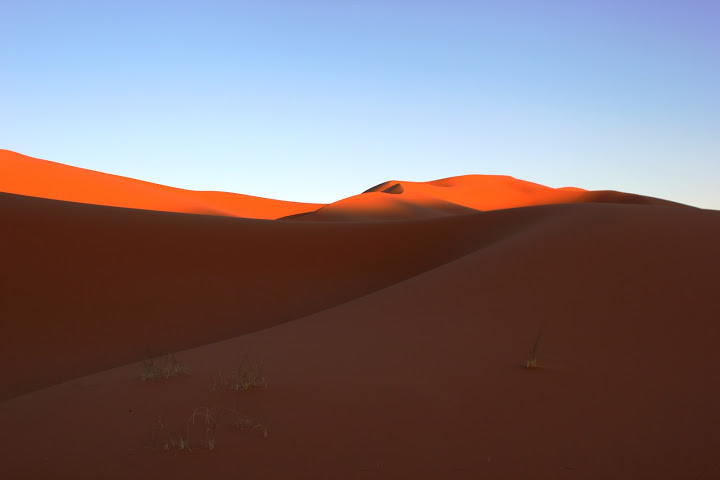
But of course it was all worth it. The Sahara is one of the only places I’ve seen that is, actually, just like the best pictures you see of it. Obviously, it’s better and more dramatic in person but the colors, the shape of the dunes, it’s totally other-worldy and pretty incredible. It literally seems to come out of nowhere. You drive forever, first on the highways and then through this bumpy desert and all of a sudden the dunes just appear, and then go on, seemingly forever. And riding through those dunes while the sun rose and people laid out carpets to pray on the sand was something we won’t soon forget.

A weed grows in the Sahara
We were, of course, really lucky. We had a pair of adventurous grandparents on hand, an amazing guide and a really tolerant baby. We couldn’t have had this experience without those things.  It was an unforgettable adventure which we’re really fortunate to have been able to have.

The center of a Venn diagram: entitled absurdity, adventure, beauty 
People told us the south would feel much different than the north and that was really true. Morocco is roughly the size of Oregon but the landscape is incredibly diverse. One thing that was not different, however, was the kindness of the people we met. From the guides to the people in cafés who, as usual, passed Cecily around from table to table we found Southern Moroccans (with the exception of the medina boss) as much of a joy to be around as Northern Moroccans.

Meeting friends and influencing people. 
Still, while I'm happy to report that it was not ALL Type 2 Fun, we were glad to head home. Moroccans have a tendency to be extra loyal to their hometowns, to the point where we're constantly being warned that the next place we visit is filled with rascals. There, after many acts of kindness, they will warn us in turn about the next town we're visiting. We’ve always found this funny, and sort of thought people were just being hyperbolic. It couldn’t really be THAT different could it? But of course it could and it is. One of Morocco’s charms is its diversity—both in terms of the people and landscape. And after leaving Tangier for a while we could see why people grow so loyal to their home towns. Along the way we found ourselves missing our city and feeling grateful that we landed where we did. So perhaps, while we’re still making social gaffes on the regular and limping through Darija we’re becoming a bit more Moroccan after all.  
Last stop at Ait Ben Haddou.

Monday, February 15, 2016

Running

(OR: How I Came to Discover Tangier as the Ultimate Running City)


When arrived in Tangier, I had just completed the Seattle Marathon, my first. I didn't plan on doing any running here (or, perhaps, anywhere, ever), because I thought that it would be too crowded, too busy, and too incongruous. In Tangier, I had rarely seen anyone exercising outside of the gym. In fact, I think that I've never even seen a Moroccan man wearing shorts!

So, for the first month in Morocco, I didn't do any running (OK, actually no exercise at all). We signed up for a gym membership (the infamous CLUB OMNI-SPORT), and Kate faithfully went. Each day, I invented new and elaborate excuses to stay home. Finally, by the time mid-January rolled around, I knew that I needed to do something. My baguette consumption had reached near-epic proportions, and I was also just getting a little stir-crazy. That's when I realized that the Marrakech Marathon would coincide with our visit to the south of Morocco. I signed up for the half-marathon three weeks ahead of time and this finally pushed me out the door, running shoes laced up. I was counting on a short burst of training, along with a lot of stored miles from the marathon, to see me through.

My first run was basically what I feared--lots of cars, crowded streets, and strange looks from pedestrians. I've been taking inordinate pride in beginning to blend in a little more; Knowing where I'm going in the city, disguised behind a Moroccan mustache, and dressed up a bit more than usual, I sometimes don't get noticed as anything more than another Tanjawi headed somewhere. Running blew my cover, big time.

However, I stuck with it (the thought of exploding in a half-marathon helped spur me on), and I quickly discovered some tweaks that made running in Tangier more agreeable. The first one was strictly geographical. About a mile from our house, the Route de la Plage Mercala winds along the water, providing stunning views, as well as a far less crowded venue for running. Many days, lots of folks are out on this stretch of road, walking or running.

Not a bad place to go for a jog.
Similarly, I realized that, at least on the long runs, one gets out of the city amazingly quickly. In just five miles of running, you can go from crowded streets, full cafes and bustling market stalls to wide, streets and forested hillsides.

Yes, that is a sign warning to watch out for wild pigs!
The other tweak that helped me realize that Tangier is an amazing running city has just been a mental shift--to accept a little incongruity. After all, one of the main draws to Tangier for the authors that I'm studying has been the city's acceptance of eccentricity. Who cares if I put on short-shorts and jog through a food market every once in a while? Most of the Moroccan seem to shrug it off. The funniest reaction is from the guys at the churro stand near my house. Each morning as they're setting up their food stall, they notice me jog by, the picture of virtuousness. Then, three hours later, I buy a huge quantity of their incredibly delicious, unhealthy churros. Two steps forward, one step back.

These guys have some hard questions about the overall health plan.
Rediscovering running has also led to lots of positive interactions with people. Because I'm already exercising, bystanders are incredibly willing to enlist me in physical tasks. I've helped put a couch on top of a grand taxi for transport, and pushed an overloaded cart up a hill, just like a warm weather version of the training montage in Rocky IV.

All of this training culminated in the Marrakech Marathon at the end of January. I was shocked by how many runners participated--there were 6000 runners in the half-marathon alone! At the start line, I seemed to be the only one without a smart phone, selfie stick, and hydration pack. A moving moment passed before the gun went off, when a giant Moroccan flag was unfurled, and a huge cheer rose from the crowd.
In the courtyard of the riad in Marrakech.
The half-marathon followed a beautiful route into the heart of the new city, through two gardens, and then along the ramparts of the old city back to the finish line. The mix of languages during the race was amazing--cries of "Bon Courage!" and "Saha!" were heard in equal number. At one point, a Moroccan runner turned around, raised his hands in the universal "raise the roof" motion, and, with a hearty "Allahu Akbar!" encouraged those following behind.

What will remain for me, though, is a moment towards the end of the race. It had gotten hot, and I was in pain. I stopped at the last aid station, 5 kilometers before the finish. At aid stations, rather than dispensing unpalatable Gu Energy Gels, they simply offered tangerines, which you peeled and enjoyed as you ran. I grabbed two, eating them at a fast walk. I looked around at my fellow runners, and at the spectators who lined the course, the colors vibrant in the sunlight. Just then, I moved--blessedly--from sun to shade, and happened to look down. The ground was completely covered in crushed, fragrant orange peels discarded by faster runners, like a magic carpet that would carry me to the finish.

Thursday, January 28, 2016

At the Legation

A funny thing about keeping a record of our experience living here is that we're drawn to the noteworthy, possibly to the exclusion of the day-to-day. Because of this--and on the eve of our departure for a trip to southern Morocco, which is sure to bring more adventures and vistas--I thought that I'd just post a few things about the Legation, which is where I've been doing the majority of research for my class, and which is, in itself, worth a trip to Tangier.

No big deal, but my library is SUPER OFFICIAL.
My responsibilities for my Fulbright are pretty neatly divided into thirds: I audit university-level classes, I visit and interact with students at primary and secondary schools here in Morocco, and I complete a capstone project. For my project, I've been working on designing a place-based course--suitable for American high school students--which might draw them into the multicultural city of Tangier through it's literary history, both North African and expatriate. Many know that Tangier was a hub for Americans writers living abroad in the late 1950's and into the 1960's--it's closely associated with the Beat Movement, and sort of centered around Paul Bowles. This literary history is fascinating, and only made more fascinating by the inclusion of early explorers to the city (who included Mark Twain and Samuel Pepys) and visitors from the city (Tanjawi Ibn Battuta was one of the most prolific travelers of the ancient world). There are a number of Moroccan writers in translation who complement this history.

TALIM: Sounds a bit like a James Bond villain's lair, but, then again, Ian Fleming did write here in Tangier.
Wrangling all of this information together is where TALIM has been truly amazing. The library here at the Legation is absolutely amazing--with old Tangier newspapers, every book that one might want about the literary history of Tangier, and a quiet, studious space to work. On the second floor of the library, I've established a little nook where I can put together my class, read, and post baby videos to Tumblr. Likewise, interesting people--drawn to TALIM--are always dropping in for a day or week, and I've learned a lot from talking to them.

Akane, a graduate student from New York, perusing the old Tangier Gazettes.
Of course, for a visitor, the real draw of TALIM is the amazing history of the place, and the top-notch exhibits within it. The Tangier Legation is the first American public property outside the United States, and has a long and colorful history of use--for over 140 years! It's not well-known in America--though it's better known here--that Morocco was actually the first country to officially recognize the United States, and the 1786 Moroccan-American Treaty of Friendship is one of our oldest treaties. Over the years, the Legation has been a diplomatic hub, a spy base, and, now, a museum and cultural center.

The beautiful Moorish entryway to the museum.
Some of the fascinating things inside the museum are primary source documents of Tangier history, as well amazing stories of Moroccan-American relations, such as in 1839, when the United States tried to get out of receiving an unusual gift from the Emporer--a lion and lioness. Refusing the gift proved very difficult for the consul, Thomas A. Carr, and he eventually relented. Anyone who's had a meal with a Moroccan family knows that they can be relentless in their generosity! Likewise, the Perdicaris Affair has it all--pirates, kidnappers, and a Teddy Roosevelt. These exhibits, as well as what you can find in the archives of the Tangier Gazette, make TALIM such an amazing resource, as well as just a great place to visit.

A prophetic headline from 1949, though I'm not sure that they mean this the way that William S. Burroughs will.
Ultimately, though (this seems to be a theme on our blog), it comes down to the people. From John Davison, the director, to Yhtimad Bouziane, the associate director, to the guards and everyone else, the Legation has been a wonderful touchstone. I enjoy coming as soon as it opens, walking the narrow streets into the Medina through "The American Gate," and getting the chance to research and write and think in the most convivial possible environment. Usually, I leave at lunch, off to visit a school, or watch Cecily while Kate's Spanish class is in session. Either way, like the Thomas A. Carr, I'm overwhelmed with the hospitality that I've encountered here.

A welcome sight each morning.

Sunday, January 24, 2016

Update: Moroccats

We now interrupt our Very Important Travel Blog for an update from the international animal kingdom.

Most of you already know that we have a fat, pampered housecat who goes by the name of Monster. Kate rescued him as a kitten from a snowbank, Elliot quickly warmed to cat ownership. We’re both very invested in his well-being. Just for a little context, Cecily’s first difficult life lesson was learned this summer when Monster commandeered her bassinet. So that’s backstory.   

The pleasant surprise is that Moroccans seem to share our feelings.

When we moved here we noticed two cat-related things. The first was that there were a lot. We worried that this might be one of those depressing scenes with one-eyed, one-legged, mangy cats, scrounging in garbage cans and fighting for survival and resulting in us adopting five new household members. And getting fleas.

An irresistible little fleabag.
But then we noticed the second thing: the cats around Tangier—though they obviously live on the streets—seem particularly well-cared for. For one thing, they constantly eat fish—small, fresh, silver fish from the sandwich shops, fish-peddlers, and straight off the hook down at the pier. There are always bowls of fresh water and milk around, and many cats have beds in shops, even high-end luxury shops. Cats lie on beautiful Moroccan carpets and snooze in slanting sunbeams on café chairs that otherwise could have gone to customers. In fact, last week when Elliot got up to go to the bathroom at a restaurant, a small black kitten stole his seat and refused to relinquish it, confident that the waiter would side with him (he did).

Cappuccino, extra foam.  
An explanation for this attitude, amazingly, lies in the Koran.
Prophet Muhammad (peace and blessings of Allah be upon him) was tender and kind towards cats. He (peace and blessings of Allah be upon him) appreciated cats. Hazrat Muhammad  (peace and blessings of Allah be upon him) 's  favorite cat was called Muezza. There is a well-known story regarding the Prophet Muhammad (peace and blessings of Allah be upon him) and Muezza. When the call to prayers was heard, Muezza was asleep on one of the sleeves of the Prophet’s (peace and blessings of Allah be upon him) robes. The Prophet (peace and blessings of Allah be upon him) wanted to wear the robe to go to prayers. Rather than disturb Muezza, Muhammad (peace and blessings of Allah be upon him) robes cut off the sleeve to leave Muezza in peace.
Yes, you read that right. The Prophet Muhammad, peace be upon him, was not only a cat-lover, but the name of his cat is known! Is he the only founder of a major world religion who is also a pet-owner? Just for a thought experiment, imagine if Jesus had a dog named Adriel, and talked about how great he was in the Bible. One of the disciples (I’m looking at you here, Phillip) would always have to watch Adriel when Jesus went out of town. In predominantly Christian countries, one has to wonder if it would change the way that dogs are treated and regarded.

Just cattin' around in the Mediterranean sun.
Either way, the feline Tanjawis--well-fed and undisturbed--demonstrate that this is a pretty good place to be a street cat. Though cats worldwide consider themselves special, even holy, here the people around them seem to agree.

Wednesday, January 20, 2016

What's Over Here


There’s a game we like to play with Cecily called “Let’s Go See What’s Over Here.” The game is in song, because Cecily is a baby, and that’s what she’s into. It entails walking around and looking at things while singing, as Elliot recently pointed out, to the tune of Destiny’s Child’s 90’s hit “Bootylicious,” which is apparently deeply ingrained in my psyche. Our apartment in Tangier has made this game more interesting for all parties. Today, we’d like to invite you to join us…as we uncover the many wonders of our home and neighborhood.

The Morrocan homes we have visited seem to be built around entertainment and gatherings, and our place is no exception. On Friday everybody leaves work and school in the afternoon to attend mosque and eat couscous lunch. Judging from the number of holidays here, and from the sound of our upstairs neighbors, people seem to gather together whenever they have the chance. When we celebrated Mawlid with Khalid’s family we were lucky to see a Moroccan parlor used to its full effect.


The appropriate use of a Moroccan Parlor
But we've found other uses as well...

Like nudist colony
Or a Renaissance Art Gallery 
We live on the ninth floor, and like everyone else we hang our laundry outside of our kitchen window. It’s exciting. At first I got nauseous every time I hung up a t-shirt. Now that I’m fairly assured I won’t spontaneously fall to my death, it’s just business as usual.

Where laundry goes to die (notice the ill-fated black sweater below) 
Cecily in her room, where she squirrels away all of her gifts.

Some of Cecily’s possessions: a turtleneck from a man on a bus, a basket from a man in the market, the banana, forever captive.
She gets other things, too, which she is not allowed to keep in her room. Last night the waiter brought her a flan, which we pretended to feed her and then ate ourselves.

Our apartment is owned by Khalid’s sister Najat and she has been a wonderful part of our experience here. From coming to the rescue at 9:00 PM when I blew a fuse (with my breast pump, unfortunately) to dealing with our questions in broken Spanish/French/Darija  she has been really wonderful. A major bonus: On Fridays Najat often surprises us with the traditional couscous lunch. It feeds us for days.

We’ve both grown pretty attached to our neighborhood. It’s lively at all hours, and full of interesting cafes and shops. We have a bakery, complete with an intimidating and serious baker who makes ten cent baguettes with a wood fired oven.

When we moved in to the neighborhood I think they had to double the wood load
“You’ll find everything you need right here in this neighborhood,” Khalid promised when showing us around. Which, it turns out, was sort of an understatement.

Good fruit
There are some things we don't really need...

Like these things...1 KG for $1.40.  

And some things we do...

I need these smoothies, which taste best when served by a disembodied hand. 
Separate days for men and women. Elliot’s working on Musculation, I’m focusing on Gymnastique and (not to brag) Cecily is looking forward to attaining her Black Belt by the time we leave.
Elliot’s new barber is putting his former barber (me) to shame.

 After, with the artiste. 
Before (Elliot's the one in the green) 


We are homesick for our animals and our fireplace and our backyard (even if it is covered in four feet of snow). We miss water pressure and indoor heat and not having to walk down eight flights of stairs and worry about getting hit by a motorcycle or car when we leave the house.  Being foreign is, predictably, exhausting at times. Misunderstandings abound. It’s hard to know what language to use when, and even harder to use that language in a way that is even semi-effective. And truth be told, we don’t really know how to utilize a Moroccan parlor in all its elaborate grandeur.

Some of us are more comfortable with the decor than others...After a long day of being carried around Cecily gleefully relaxes in her throne.
So it’s been nice to have an apartment and neighborhood that feel like home. Our apartment here is basically the opposite of our house in Idaho, which is cozy, low-ceilinged, couchless and simple. And while the gilded...everything…might cause a bit of sensory overload, we’ve grown fond of the big rooms, and the long couches and the way our kitchen windows look over the city. Living in such a bustling neighborhood is a nice change of pace. At this time of year in Hailey it’s possible to go days without seeing our neighbors.    Here, everyone knows each other. Many people have lived in this neighborhood for their whole lives. The produce guys know what you want before you even ask and they pinch Cecily’s cheeks while I clumsily count out change and there’s a café where the people know (our daughter’s) name and pass her around while we drink our coffee. I love waking up with Cecily before it’s light out and looking out at the flocking seagulls and momentarily quiet streets. And the sounds of the call to prayer that we can hear coming from multiple directions has made Cecily’s bedtime routine much more dramatic.

Elliot's mustache takes an important phone call.   

Out on the street there’s a lot of embracing. A  lot of kissing of cheeks. “Saalam-Alaikum,” people say in passing. “Peace be upon you. How is your mother how is your father how is your health how is your daughter? Thank God, Thank God, Thank God.” It’s possible this is what I will miss most of all. Well, that and the baguettes.

Monday, January 11, 2016

Good Question

My favorite activity related to my project is spending time in the schools here in Morocco. With the help of Mr. Hussein Zelji and Mr. Ahmed Taie, I've gotten a chance to observe and participate in classes at all grade levels, in schools both public and private. Both Hussein and Ahmed are Inspecteurs, administrators who helps develop and evaluate teachers. This is a different system than the U.S., where a building principal is also typically the academic leader. Instead, the principal runs things on the ground, but the inspecteurs are the ones who stop in--typically unannounced--to observe classes.

When your school schedule looks like this, it make sense to have one administrator work on the schedule and another to evaluate the teachers.
Hussein, with whom I do most of my observations, supervises more than 250 teachers, in schools throughout Tangier and as far away as Chefchaouen. It's a huge job, and I'm constantly amazed at his equanimity, his sense of humor, and his willingness to take some random teacher from Idaho with him on his observations. Typically, I'll be working away at the American Legation, researching my project, and Hussein will call me to tell me that he's going to look at a school. While I know that I need to get my research done, these calls are impossible to resist, because--as all teachers know--it's more fun to be in school than in the library!

Hussein's visits can be stressful for the teachers, though I've known him only to be fair and direct with them. For my part, I've learned a tremendous amount from these observations, both from the terrific teachers and from Hussein's educational leadership. That, however, is a post for another time, because I want to discuss what usually happens at the end of my observations with Hussein, who often asks the teacher to leave fifteen minutes for students to ask me questions.

As an English teacher, I'm often more interested in pursuing questions that don't have one right answer in my own classes. However, for you, the loyal reader, I am going to provide the most common questions that Moroccan students ask me, along with the best answer--standardized test style--that I've discovered through a process of trial and error.

Question: "Are you a Muslim?"

This is always the first question that Moroccan students ask me. What I didn't realize at first is that they mean it in a completely neutral, non-judgmental way.  Here, because everyone is muslim, religion isn't considered nearly as personal (for lack of a better word) as it is in the United States. Not realizing this, at first I tried to soften my answer, by saying things like, "Not yet," which, while technically true, just leads to further questions about the process of becoming a muslim and my interest in doing so. So, for this question, for non-muslims, the correct answer should be decisive. Also, I've learned not to be awkward about it--they're just asking!

Best Answer: "No."


Just try telling this scary bunch that you're not a muslim.

Question: "What football club do you support?"

This is another common question that I basically didn't understand well at first. For a while, I told students that the team that I support is the Ghana Black Stars. This is another answer that is technically true, but completely misunderstands the question. It took some time in the cafes, and talking to students, to understand that this question is only about Spain's La Liga, and, more specifically, there are only two possible answers: Real Madrid or FC Barcelona. In the grand tradition of wannabe fans, I picked one at random, and NOTHING WILL EVER MAKE ME CHANGE MY MIND.

Best Answer: "FC Barcelona."


The Barca fans wanted to take a photo with me.

Question: "How do you find Morocco?"

Students almost always ask me about the experience of being in Morocco, and it's one of my favorite questions to answer, because--as readers of the blog will have surmised--I love Morocco! Students seem generally to agree with this point of view, as do most Moroccans, actually. I've found that Moroccans seem to be quite patriotic, and think that Morocco is a great place, or at least a good place that's getting better. Some of the students have a more pessimistic outlook on Morocco, which is the result of being a teenager. Either way, the best answer here is the truth.

Best Answer: "Morocco is awesome!"


Schools share common DNA wherever you go.
From here, questions seem to vary widely, depending on the age of students and what they've been studying in class. Once, Hussein asked me to share some thoughts about R. Kelly, whose song, "The World's Greatest," they had been listening to in order to practice their English. Delivering an impromptu lecture on R. Kelly in front of a audience of Moroccans teens is like something from a nightmare. Should I try to explain "Trapped in the Closet," R. Kelly's rap opera? Sing "Remix to Ignition" and reminisce about senior year of college? Fortunately, I was saved by the bell.

On another occasion, I had created some minor level of pandemonium with my assertion that Barca is OBVIOUSLY the best football club, and the room was full of background noise as students each argued their side of the football club rivalry. However, in the front row of the class, Said, a reserved, very sharp young man who had given me a tour of the school earlier, had a question for me, though I couldn't hear him well over the noise. I leaned forward.

Question: "Do you respect the blacks?"

I'm always interested to know what Moroccans think about, or hear about, the United States (recently, I wondered about this and Donald Trump in a guest opinion for the Seattle Times.) I asked Said what he was referring to, and he sort of mumbled, "Well, the police..." and trailed off, out of words. I can sympathize. It's pretty hard, given the past years that we're having in the US, to find the vocabulary for Ferguson, Freddie Gray, or Tamir Rice, even for native speakers. I told him that it was a problem, one that has existed for a long time, and continues to divide Americans about how best to solve it. I tried to explain Black Lives Matter. Said went on, "But then, the president, he is black!" He shrugged his shoulders, as if to say, it doesn't make sense. Unfortunately, there are some questions that just don't have easy answers.